

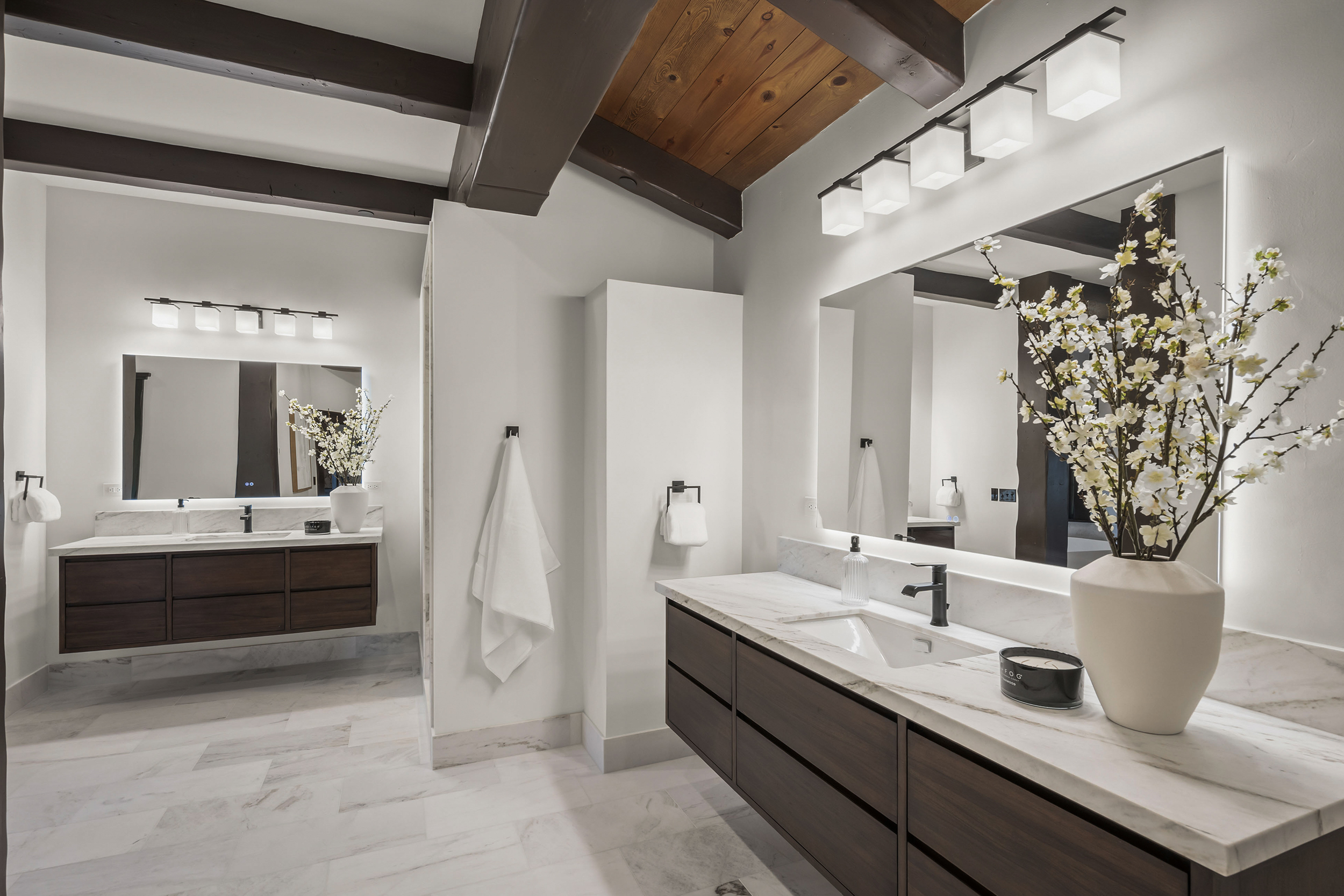
The First 60 Seconds Tell Us a Lot
When we walk into a $10 million home, we’re usually not looking at the kitchen first.
We’re looking out the windows.
We’re looking next door. We’re noticing the light, the privacy, the orientation of the home and how it sits on the property. We’re paying attention to what feels exceptional, but we’re also looking for the things no amount of beautiful staging or expensive finishes can change.
After years of touring luxury homes throughout Incline Village, Crystal Bay and Lake Tahoe, we’ve learned that some of the most important clues about a property reveal themselves remarkably quickly.
Luxury buyers are often presented with a long list of impressive features: imported stone, designer appliances, custom cabinetry, smart-home technology and expensive furnishings. Those things matter. But they aren’t necessarily what determines whether a property is truly special or whether it will hold its value over time.
1. The Property Before the House
Before we fall in love with the architecture, we want to understand the land underneath it.
Where does the home sit within the neighborhood? What surrounds it? How private is it? What can you see from the primary living spaces, and just as importantly, what can other people see of you? Are neighboring homes likely to affect the experience of the property? Is there road noise? How does the driveway work in winter? Where will the snow go?
In Lake Tahoe real estate, these questions can matter enormously because the most valuable characteristics of a property are often the ones a future owner cannot create.
You can remodel a kitchen. You can replace flooring. You can reconfigure rooms and, in the right circumstances, substantially transform a house.
You can’t move the lot.
That’s why one of our first instincts when touring a luxury property is to look beyond the house itself. A spectacular home can be improved. An irreplaceable setting is much harder to find.
It’s also why we sometimes become more excited about a property that needs work than one that’s completely finished. If the underlying real estate is exceptional, the house can often become what you want it to be.
We’d rather help a buyer recognize something irreplaceable than be distracted by something replaceable.
2. The View, Including What’s in Front of It
In Tahoe, “lake view” can mean almost anything.
It might be a dramatic, unobstructed panorama that stretches across the lake, or a narrow glimpse between two trees from one corner of the house. Both can technically be described as a lake view, but their value and the experience of living with them are entirely different.
When we tour a luxury home, we’re not simply asking whether it has a view. We’re studying the quality of that view.
How much of the lake can you see? From which rooms? Is the view straight ahead or do you have to walk to a particular window to find it? Can you see the lake while sitting down in the living room or lying in bed, or does the view disappear once you’re no longer standing?
We also pay close attention to what’s between the house and the lake.
Trees can beautifully frame a view, but they can also substantially change it. Neighboring rooftops, utility lines, roads and future construction can affect what feels spectacular today. Even the orientation of the house matters because light, glare and the position of the sun can dramatically change how a view feels throughout the day.
Some of our favorite Tahoe properties don’t necessarily have the widest views. They have views that are beautifully composed. Pines frame the lake. The mountains create depth. The water appears exactly where you want it from the rooms where you actually spend your time.
And then there are properties where the view is so extraordinary that it becomes the reason to buy the house.
That’s an important distinction, particularly at the luxury level. Finishes can be replaced and architecture can evolve. A truly exceptional Lake Tahoe view is much harder to recreate.
When we’re evaluating a view, we’re not asking whether it’s beautiful. We’re asking how rare it is.
3. Natural Light & Orientation
A home can have enormous windows and still feel surprisingly dark.
That’s why we pay attention not only to how much glass a house has, but also to its orientation, the surrounding trees, the neighboring homes and the way natural light actually moves through the rooms.
In Tahoe, this can make an enormous difference. A heavily wooded setting can be beautiful and private, but it can also limit sunlight. Two homes with similar floor plans and similar views can feel completely different simply because of the way they sit on their lots.
We’re also thinking beyond the exact moment we’re standing there. A house that feels bright during an afternoon showing may be very different in the morning. Seasonal changes matter too. The sun sits lower in winter, trees and snow affect reflected light, and the experience of a home can change significantly throughout the year.
We pay particular attention to the rooms where people actually live. Does the kitchen feel bright in the morning? Does the great room get beautiful afternoon light? Does the primary bedroom feel warm and inviting, or dark even on a sunny day?
And then there’s the relationship between light and the view. Sometimes the most dramatic wall of glass isn’t necessarily the one that creates the best living experience. Glare can make certain rooms uncomfortable at particular times of day, while the right orientation can make the lake, mountains and surrounding landscape feel almost like part of the interior.
These are subtle differences, but at the luxury level, subtle differences can have a very real impact on how much buyers love a property and ultimately how they value it.
A beautiful house catches your eye. A beautifully oriented house changes the way it feels to live there.
4. The Floor Plan: Does the House Actually Live Well?
Square footage tells us how big a house is. It doesn’t tell us how well it lives.
We’ve toured enormous homes that somehow feel cramped, and smaller homes that feel remarkably generous. Usually, the difference comes down to the floor plan.
Within the first few minutes, we’re looking at how naturally the house flows. Does the entry make sense? Are the kitchen, dining and living spaces connected in a way that works for everyday life as well as entertaining? Can you move through the house without constantly encountering awkward hallways, unnecessary stairs or rooms that seem to exist simply because there was space for them?
We’re also looking at where the square footage went.
A 7,000-square-foot home can sound impressive until you realize a surprising amount of that space is devoted to circulation, oversized secondary areas or rooms you’ll rarely use. Conversely, a thoughtfully designed 5,000-square-foot home can feel substantially larger because nearly every square foot has a purpose.
Bedroom placement matters too. Is the primary suite positioned for privacy? Are guest rooms truly comfortable for guests, or simply additional bedrooms on a floor plan? Is there separation when you want it and connection where it matters?
For many Tahoe buyers, we’re also thinking about how the home functions when it’s full. These houses often become gathering places. Friends arrive for ski weekends. Adult children come home. Guests stay longer than expected. A floor plan that feels wonderful for two people still needs to work when the house suddenly has ten.
Then we look at the relationship between indoors and outdoors. Can you move naturally from the kitchen and great room to the deck or patio? Does the outdoor living space feel like an extension of the house, or does getting there feel like an afterthought?
These aren’t necessarily the things that jump out in listing photos. But they’re often the things buyers notice after they’ve lived in a home for six months.
The best floor plans don’t make you think about the floor plan at all. The house simply works.
5. Scale, Proportion & the Details You Feel Before You Notice
Some homes feel expensive the moment you walk through the door, even before you can identify exactly why.
Often, it comes down to scale and proportion.
We’re looking at ceiling heights, the size and placement of windows, the width of hallways, the relationship between rooms and whether the architecture feels balanced. A soaring great room can be spectacular, but bigger isn’t automatically better. If the proportions are wrong, an enormous room can feel cold and cavernous rather than inviting.
The opposite is true as well. A home doesn’t need 25-foot ceilings to feel luxurious. Thoughtful ceiling heights, well-placed windows and beautifully proportioned rooms can make a smaller space feel far more sophisticated than its square footage would suggest.
This is also where we start noticing the details that separate genuinely high-quality construction from a house that simply has expensive finishes.
We look at the windows and doors. The cabinetry. The stonework. The millwork. The hardware. How materials transition from one room to another. Whether the details feel intentional or whether someone simply selected costly products and put them all in the same house.
There’s a difference between expensive and well built.
Beautiful countertops and designer fixtures are easy to recognize in photographs. Exceptional craftsmanship can be more subtle. Doors feel substantial. Cabinetry closes perfectly. Stone is carefully matched and installed. Trim lines are precise. Materials feel appropriate to the architecture rather than chosen because they happened to be fashionable when the home was built.
We’re also thinking about how those choices will age. Some homes are unmistakably tied to the year they were designed. Others use natural materials, thoughtful proportions and quality craftsmanship in a way that can remain relevant for decades.
At Lake Tahoe, we particularly appreciate homes that feel connected to their surroundings without becoming overly thematic. Wood, stone, steel and glass can be beautiful here when they’re used with restraint and intention.
The best luxury homes don’t need to announce that they were expensive to build. You can feel the quality without being told.
6. What Has Been Disguised by Great Staging?
Great staging can completely transform the way a home feels, and that’s exactly what it’s supposed to do.
Beautiful furniture establishes scale. Rugs define spaces. Art draws your eye to the right places. Lighting creates warmth. Even something as simple as where a sofa is positioned can change the way you perceive a room.
We appreciate exceptional staging, especially when we’re selling a home. But when we’re evaluating one for a buyer, we’re mentally removing all of it.
We’re looking past the furniture, artwork and perfectly placed accessories and asking what the room would feel like empty.
Is that enormous sectional making an awkward great room feel more intimate? Is a rug disguising dated or damaged flooring? Is furniture positioned in a way that keeps you from noticing an unusual traffic pattern? Are lamps compensating for a lack of natural light? Is an oversized piece of art drawing attention away from a window that looks directly at the neighboring house?
Fresh cosmetic updates can have a similar effect. New paint, contemporary light fixtures and beautifully styled furnishings can make an older home feel dramatically more current without changing the underlying architecture, systems or construction quality.
That doesn’t make those improvements unimportant. Sometimes relatively simple cosmetic changes are exactly what a property needs. The key is understanding what you’re actually buying and separating improvements that are easy to replicate from characteristics that have real, lasting value.
We do the reverse when we’re representing a seller. If a great property isn’t showing as well as it should, we want to identify what’s preventing buyers from seeing its potential. Sometimes the underlying real estate is far better than the current presentation suggests.
Whether we’re buying or selling, the objective is the same: understand the property underneath the presentation.
7. How the House Handles Tahoe
A home can be spectacular in July and a completely different experience in February.
That’s why, when we’re touring a Tahoe property, part of our attention is always on how the house functions in the mountains. These aren’t necessarily the glamorous features that make the listing photos, but they can have an enormous impact on everyday life.
We look at the driveway. How steep is it? What’s the sun exposure? Is it heated? Where will the snow be pushed after a major storm, and is there actually enough room to put it?
Then we start thinking about how people enter the house in winter. Is there a functional mudroom? Is there somewhere for ski boots, helmets, jackets and wet gear that doesn’t involve walking through the main living space? Can you get from the garage into the house comfortably during a storm?
Garages and storage matter more here than many buyers initially expect. Beyond cars, there may be skis, bikes, paddleboards, golf clubs and all the equipment that comes with living in Tahoe. A beautiful home with nowhere to put any of it can become frustrating surprisingly quickly.
We also pay attention to heating systems, snowmelt, backup power and the practical details of maintaining the property through winter. Radiant heat can be wonderful. A generator may not seem particularly exciting until the power goes out during a storm. Well-designed rooflines and drainage matter when snow starts accumulating.
Outdoor living deserves the same scrutiny. A gorgeous deck is only valuable if you’ll actually want to use it. Sun exposure, wind, privacy and how easily you can move between the kitchen and outdoor spaces all affect whether a deck or patio becomes part of everyday life or simply looks good in photographs.
None of this means every Tahoe home needs a heated driveway, generator or enormous gear room. It means we want buyers to understand how the property will actually function through four very different seasons.
Luxury in Tahoe isn’t just about how a home looks. It’s about how effortlessly it lets you live here.
8. What Would We Want to Change, and How Difficult Would It Be?
Almost every home has something we’d change.
The important question isn’t whether a property is perfect. It’s whether the things you don’t love are easy to fix, expensive to fix or potentially very difficult to change at all.
Paint, flooring, lighting and furnishings are relatively straightforward. Kitchens and bathrooms are more involved, but they’re still predictable projects. Moving walls, changing rooflines, adding square footage or substantially altering the way a home connects to the outdoors is an entirely different conversation.
In Tahoe, that conversation can become even more complicated.
Before assuming a home can simply be expanded or reconfigured, we want to understand the property itself. Existing coverage, allowable coverage, setbacks, topography and other TRPA and local land-use considerations can all influence what’s realistically possible.
This is particularly important with older Tahoe properties. Sometimes the house you’re touring isn’t especially compelling, but the underlying lot, coverage and existing improvements may make the property incredibly interesting. Other times, a buyer walks in imagining a major transformation only to discover that what appears simple is far more complicated.
We don’t expect buyers to know the answers while they’re touring a home. Our job at that stage is to recognize which questions need to be asked before they make a significant decision.
And this is where experience with Tahoe properties matters. When we see something that could affect a buyer’s plans, we know when it’s time to involve the right architect, builder, engineer, land planner or TRPA professional rather than make assumptions.
Sometimes the best opportunity is the beautiful turnkey home that needs almost nothing. Sometimes it’s the dated house sitting on an extraordinary piece of land.
The key is knowing the difference between what you’re buying today and what you can realistically create tomorrow.
9. What Are We Missing?
By this point in a tour, we’ve usually formed a pretty strong first impression. That’s exactly when we try to challenge it.
If we love the house, what might we be overlooking because we love it? If we don’t love it, is there something valuable about the property that we’re failing to appreciate?
We start looking for the less obvious things that could materially affect ownership or value. What’s happening on the neighboring properties? Is there future development potential nearby? Are there unusual easements, access issues or property boundaries worth investigating? Does something about the lot, structure or surrounding area deserve a closer look?
We’re also thinking about what wasn’t obvious during the showing. A quiet road at 11 a.m. may feel different at another time of day. A beautifully shaded deck in summer may get very little winter sun. A property that feels incredibly private with full summer foliage can feel different once the leaves are gone or snow changes the landscape.
That doesn’t mean approaching every home with suspicion. It means separating emotion from evaluation long enough to make sure the fundamentals support the feeling.
At the luxury level, buyers aren’t simply deciding whether they like a house. They’re deciding whether a particular property deserves a significant allocation of capital, often while comparing it with very different opportunities around Lake Tahoe and beyond.
A spectacular first impression matters. But before we’re comfortable telling a buyer that we think a property is truly exceptional, we want to understand what might not have been obvious in those first 60 seconds.
The best properties tend to become more compelling the closer you look at them, not less.
10. The Question We Eventually Ask: Would We Buy It?
After we’ve looked at the lot, the view, the light, the floor plan, the construction quality and all the practical details, we eventually come back to one very simple question:
Would we buy it?
Not whether we personally want to live there. Every buyer has different taste, priorities and needs. What we’re really asking is whether we believe in the property.
Is there something genuinely special about it? Does the underlying real estate justify the price? Are the weaknesses fixable? Are the best attributes difficult or impossible to replicate? And if the market changed tomorrow, would we still feel good about what the buyer owns?
Sometimes the answer is obvious. Other times, the most interesting properties require a little imagination.
We’ve walked through beautifully finished homes where everything looked perfect, yet something about the underlying real estate gave us pause. We’ve also toured dated homes where we couldn’t stop looking out the windows because the setting was so extraordinary that almost everything else felt secondary.
That’s ultimately what we’re trying to help our buyers recognize.
Luxury real estate is emotional, and it should be. You’re buying a place where you’ll spend time with the people you care about, entertain friends, escape for weekends or perhaps build an entirely different way of life in Lake Tahoe.
But emotion is most useful when it’s paired with perspective.
Our job isn’t to convince a buyer to love a house. It’s to notice what they may not notice, ask the questions they may not know to ask and help them understand exactly what makes one property worth pursuing while another may be easier to walk away from.
Because after touring enough exceptional homes, we’ve learned something surprisingly simple:
The properties we’d fight hardest to own are usually the ones with something money can’t easily recreate.
About Mary Kleingartner & Ryan Mitchell
Mary Kleingartner and Ryan Mitchell are luxury real estate advisors with Compass specializing in Incline Village, Crystal Bay, Glenbrook and Lake Tahoe’s Nevada side. Mary has called Incline Village home since 2002, while Ryan is a lifelong Incline Village resident. Together, they advise buyers and sellers on luxury homes, lakefront properties, new construction, development opportunities and some of the Tahoe market’s most distinctive real estate.