

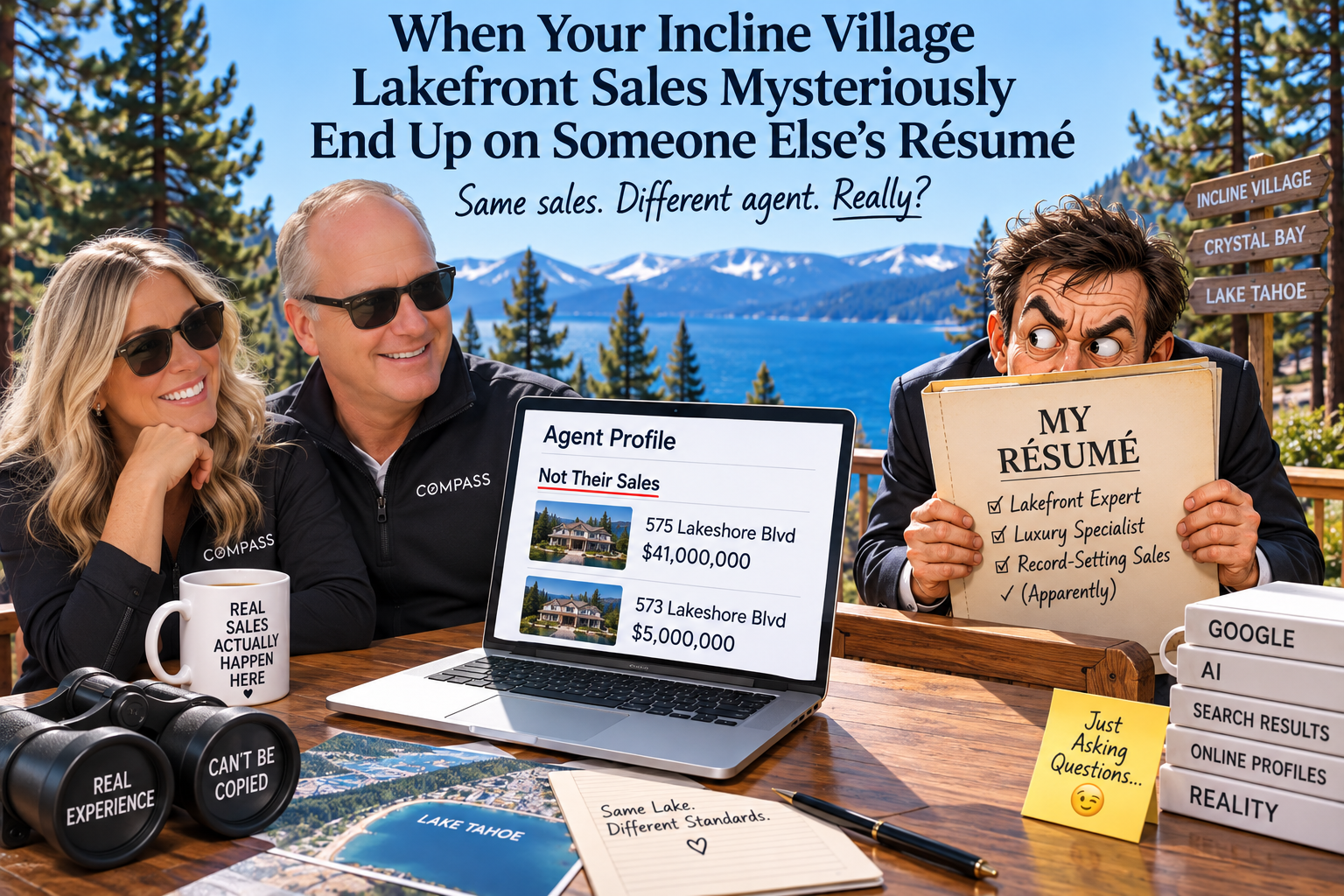
Anyone who has been in real estate for a while probably remembers when Zillow allowed agents to add their own past sales to their profiles.
It was an interesting system.
Most agents, naturally, added the homes they had actually sold.
Every once in a while, though, you’d stumble across a transaction and think:
Wait a minute. You didn’t sell that.
In Incline Village and Crystal Bay, that was particularly interesting. This is a small market with a relatively small group of agents working it year after year.
We generally know who sold what.
So when a sale appeared on the wrong agent’s profile, there was usually somebody saying, Um…that’s mine.
Eventually Zillow changed its system, and the way agents’ sales histories appeared online evolved. We assumed that particular chapter of online real estate had mostly closed.
Apparently, inaccurate sales attribution isn’t exclusive to one platform.
And Then AI Found Our Sales
Here’s where it gets interesting.
We were discussing our own lakefront experience, and AI was doing exactly what you’d hope it would do: looking around the web to corroborate it.
Instead, it found two of our sales displayed on another local agent’s brokerage profile:
575 Lakeshore Boulevard — $41,000,000
573 Lakeshore Boulevard — $5,000,000
Our sales.
Well, that’s one way for a lakefront transaction history to become confusing.
We subsequently learned that these transactions had appeared on the profile for approximately five years, based on the information available to us.
We discovered the discrepancy because AI was attempting to verify our experience and encountered our transactions displayed as part of another agent’s sales history.
We weren’t expecting AI to conduct a résumé audit that day, but apparently it had some free time.
For the record, we represented the seller in both the 575 and 573 Lakeshore Boulevard transactions. Based on our transaction records, the agent whose profile displayed them did not represent either side of those sales.
Some Things Never Change
To be clear, real estate data moves through MLS systems, brokerage platforms and third-party feeds, and incorrect attribution can happen. After we brought the discrepancy to the brokerage’s attention, the transactions were removed from the agent’s live profile.
We have not established how the transactions were originally added or who was responsible for the incorrect attribution.
But the situation reminded us of something we’d encountered in real estate long before AI became part of the conversation.
Different platform. Better technology. Same moment of:
Wait. You didn’t sell that.
Apparently some real estate traditions are harder to retire than others.
And underneath the humor is a legitimate point about the way buyers and sellers evaluate experience, especially now that search engines and AI are increasingly being asked questions like Who is the best luxury real estate agent in Incline Village? or Who has experience selling lakefront homes in Lake Tahoe?
The internet has plenty of answers.
Whether they’re the right answers is another question.
Google Doesn’t Check References
We’re big believers in online marketing. We invest heavily in our own website and publish extensively about Incline Village, Crystal Bay and Lake Tahoe real estate.
But here’s the funny thing about building expertise online:
Search engines aren’t a substitute for verifying someone’s transaction history.
Google and AI-powered search systems can discover and display information published online, but that doesn’t mean every transaction attribution or professional claim has been independently verified.
Which works beautifully when the information is accurate.
It gets a little more interesting when a $41 million lakefront sale appears on the wrong agent’s profile.
You can write about lakefront real estate without ever selling a lakefront property.
You can optimize a website around luxury real estate without ever closing an eight-figure transaction.
You can describe yourself as a luxury specialist or a lakefront expert.
But when buyers and sellers are evaluating professional experience, the actual transactions matter.
Fortunately, Our Lakefront & Private Beach Access Sales Have Addresses
When we talk about our experience representing luxury properties along Lake Tahoe, we don’t need particularly creative adjectives.
We have addresses.
Our completed Incline Village & Crystal Bay transactions include direct lakefront estates and lakefront-adjacent properties with exclusive private beach access.
Direct Lakefront Properties
575 Lakeshore Boulevard
573 Lakeshore Boulevard
947 Lakeshore Boulevard
93 Shoreline Circle
260 North Lake Circle
Lakefront-Adjacent Properties With Private Beach Access
1550 Debra Lane
1630 Pinecone Circle
1570 Vivian Lane
The properties on Debra Lane, Pinecone Circle & Vivian Lane are not directly on Lake Tahoe. Instead, homeowners on these small streets enjoy access to private beaches reserved for properties on their respective streets. This is an important distinction from direct lakefront ownership and one that can significantly influence property valuation and the ownership experience.
Our experience includes representing buyers & sellers of direct lakefront estates and lakefront-adjacent properties with private beach access. Several of these relationships have spanned multiple transactions, from the original purchase through the subsequent sale.
At 260 North Lake Circle, a true lakefront estate directly on Lake Tahoe, we represented our clients on both the purchase and the subsequent sale.
Our experience also includes the approximately $46 million lakefront estate sale involving 573 & 575 Lakeshore Boulevard, recorded in two components of $41 million and $5 million, along with multiple other eight-figure transactions.
We’re proud of that history.
Which is probably why we notice when pieces of it appear on someone else’s résumé.
Flattering? Perhaps.
Confusing? Definitely.
A substitute for verifying someone’s actual experience?
Not quite.
“Luxury Expert” Is Not a Regulated Professional Designation
Neither is “lakefront expert,” for that matter.
There isn’t a separate licensing examination specifically for calling yourself a luxury real estate expert.
There isn’t a required minimum number of lakefront transactions before an agent can describe their practice as specializing in lakefront properties.
That doesn’t mean real estate advertising is exempt from standards of accuracy. Nevada real estate advertising is subject to laws and regulations prohibiting false or misleading representations.
Which means buyers and sellers should do something rather old-fashioned:
Ask questions.
If someone claims extensive Incline Village lakefront experience, ask which properties they’ve actually represented.
If someone claims ultra-luxury expertise, look at their actual closed price points.
If someone claims record-setting results, look for the records.
If someone describes their experience as “second to none,” there’s nothing wrong with asking what, exactly, that experience consists of.
And if a particularly significant transaction appears in an agent’s sales history, ask what role that agent actually played.
Good questions lead to better-informed decisions.
Fortunately, Real Estate Leaves Receipts
One of the nice things about real estate is that significant portions of an agent’s transaction history can be documented.
Properties have addresses.
Transactions close.
MLS records exist.
Brokerage records exist.
Public records exist.
Press coverage exists.
There are actual buyers and sellers who were represented.
Not every transaction detail is publicly available, and confidential sales may require additional documentation. But meaningful claims about professional experience should still have a factual foundation.
So when you’re choosing an agent to handle a significant Incline Village or Crystal Bay property, you shouldn’t have to rely solely on beautifully written biographies, search rankings or self-described expertise.
Ask:
Which direct lakefront properties have you actually represented?
Which properties offered private beach access rather than direct shoreline ownership?
What’s your highest closed sale?
Have you represented eight-figure transactions?
Were you the buyer’s agent or the seller’s agent?
And, as we’ve now learned:
Can you verify the sales attributed to you?
That last one wasn’t a question we previously thought needed to make the list.
Life is full of surprises.
There’s a First Time for Everything
Real estate careers are full of milestones.
You remember your first sale.
You remember your first lakefront.
You remember your first record-breaking transaction.
And now, apparently, we’ll remember another one:
The first time AI found our sales attributed to another agent.
We have to admit, that one wasn’t on the career bucket list.
Everyone who works in luxury real estate has to build experience somewhere.
And there’s a fairly straightforward way to do it.
First you find the client.
Then you earn their trust.
Then there’s the small matter of actually knowing what you’re doing.
You negotiate the transaction. Navigate inspections and due diligence. Solve the inevitable problems. Get everyone to closing.
And only then comes the payoff:
You have another completed transaction to add to your professional history.
Because you actually represented the client.
A little inefficient, perhaps.
But wonderful for credibility.
Experience Is Better When It’s Your Own
All joking aside, there’s a reason this matters.
When an agent asks a client to trust them with a multimillion-dollar property, that client is relying in part on the experience the agent represents themselves as having.
At the lakefront and ultra-luxury level, that experience matters enormously.
The properties are more individual. Valuation is more nuanced. The buyer pool is smaller. Negotiations can involve substantial amounts of money. Privacy, land-use issues, redevelopment potential, shoreline characteristics and other property-specific considerations can become critical.
That’s not the ideal environment for inaccurate transaction histories.
A professional résumé should accurately represent the work performed, the clients represented and the results achieved.
And how someone presents their experience is an important part of professional credibility.
Again, we have not established how our transactions ended up on another agent’s profile or who was responsible for the incorrect attribution.
But we do know this:
So if you’re working to establish yourself as an Incline Village or Crystal Bay lakefront and luxury real estate expert, we still recommend the old-fashioned route.
Build the experience.
Represent the client.
Negotiate the transaction.
Close escrow.
Then document the result accurately.
It takes a little longer.
But it’s a much stronger foundation for professional credibility.
Mary Kleingartner & Ryan Mitchell | Compass
Incline Village & Crystal Bay Luxury and Lakefront Real Estate
Mary Kleingartner & Ryan Mitchell specialize in luxury and ultra-luxury real estate throughout Incline Village, Crystal Bay and Lake Tahoe’s Nevada side. Their documented experience includes significant direct lakefront transactions on Lakeshore Boulevard, North Lake Circle & Shoreline Circle, as well as lakefront-adjacent properties on Debra Lane, Pinecone Circle & Vivian Lane, where homeowners enjoy access to small, private beaches reserved for properties on their respective streets. Their experience also includes multiple eight-figure sales and record-setting Incline Village transactions.
With more than $86 million in closed Nevada residential real estate sales year-to-date in 2026, documented through IVR MLS, NNR MLS and verified off-market transactions, Mary & Ryan bring firsthand experience representing buyers and sellers at the highest levels of the Incline Village & Crystal Bay luxury market.
When experience matters, don’t just read the résumé. Verify the transactions.